Sub-Saharan Africa's healthcare system faces several significant challenges. These include insufficient funding and resources, a severe shortage of healthcare workers, inadequate infrastructure, and high out-of-pocket costs for patients.
As a result, many people have limited access to care, a situation further exacerbated by geographic disparities and political instability in the region.
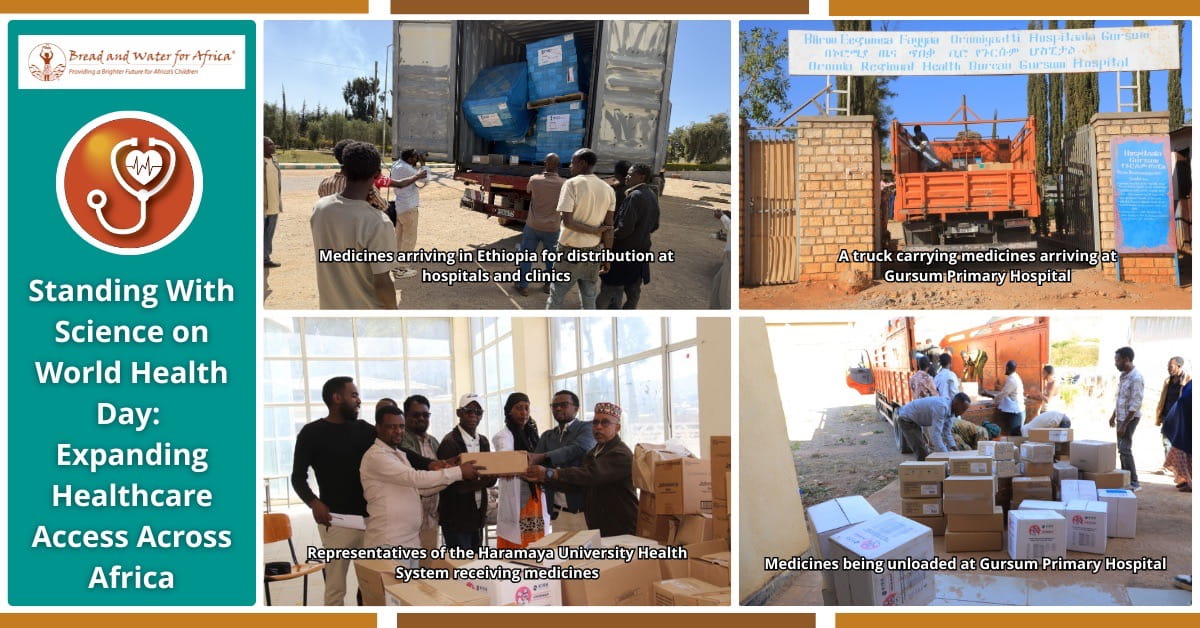
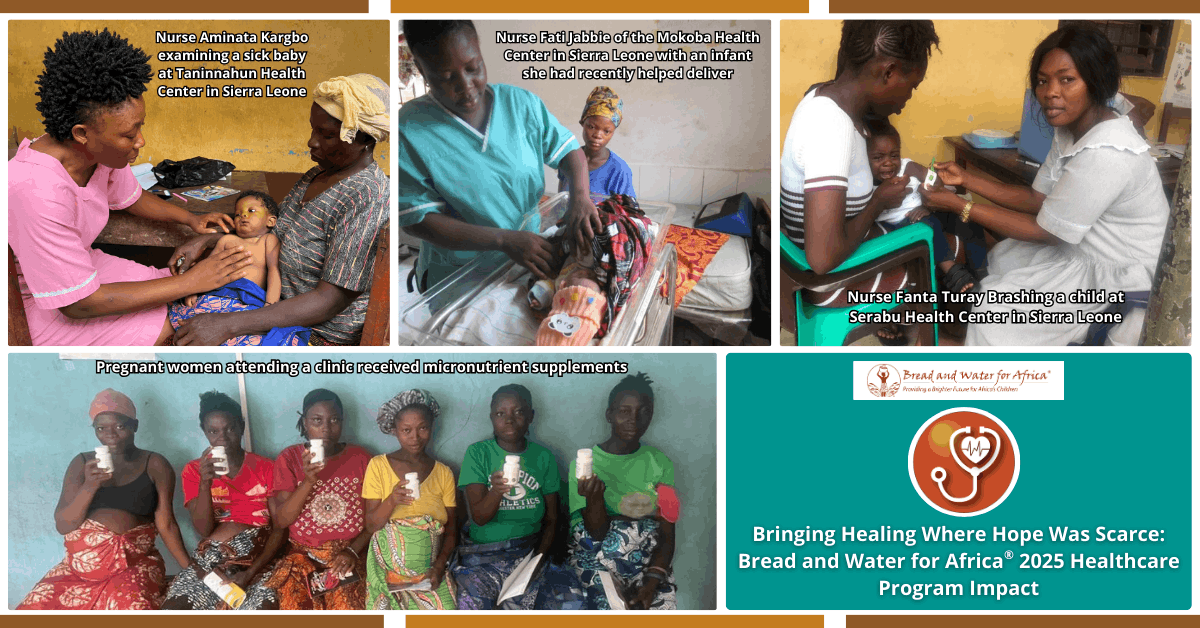
To address this critical need, Bread and Water for Africa® provides cash grants for the operating costs of remote village health centers, as well as in-kind support, including medicines, medical supplies, mobility aids, Micronutrient Supplements (Prenatal Vitamins), and hygiene supplies (such as sanitizing supplies, gloves, and masks).
In 2025, Bread and Water for Africa® shipped 7 containers of pharmaceutical and medical supplies.
In total, more than 114,109 individuals received healthcare services across 70 hospitals, health centers, and clinics in eight African countries. This included 2,557 people in Malawi, 686 in Kenya, 5,155 in the Democratic Republic of the Congo (DRC), 77,311 in Sierra Leone, and 28,400 in Ethiopia.
We collaborated with community partners, including the Rural Youth Development Organization (RYDO), Sierra Leone Mission and Development (SMD), Debre Tabor University (DTU), the United Methodist Church of Sierra Leone (UMC), Our AIM Foundation (OAF), Kebeneti Dispensary (KD) and TECHNOLOGIES APPROPRIÉES POUR LE CONGO (TAC Asbl) in DRC.
In addition, this year, Bread and Water for Africa® funded the construction of the Kagbaima Health Center, located in the Kagbaima community, to serve ten nearby villages. The health center serves more than 4,500 individuals annually.
Bread and Water for Africa® continues to support a highly cost-effective mobile clinic initiative in collaboration with OAF, serving around 25,000 residents across 125 villages in the Traditional Authority of Mkanda, Malawi.
OAF and Bread and Water for Africa® also collaborated to construct the Nafuse Health Center in Mbewa village, Malawi.
This year, the final phases included constructing the Doctor's Room and procuring equipment for the Emergency Room, sponsored by Bread and Water for Africa®.
Bread and Water for Africa® also continued this year to work to reduce high maternal and child mortality rates by providing Micronutrient Supplements (Prenatal Vitamins) to pregnant and breastfeeding mothers in Ethiopia and Sierra Leone.
Many women in sub-Saharan Africa experience deficiencies in essential vitamins and minerals, such as iron and folic acid, due to limited access to nutrient-rich foods.
These supplements aim to address these deficiencies and reduce the risks of complications like anemia and neural tube defects, thereby contributing to public health strategies to lower maternal and infant mortality rates in the region.
Highlights for 2025 include:
❖ In Sierra Leone, Bread and Water for Africa® collaborated with SMD, RYDO, and UMC to provide care for over 72,460 individuals at 55 healthcare facilities. Additionally, the project supplied mobility aids and hygiene products to those in need.
❖ In Ethiopia, Bread and Water for Africa® partnered with DTU's Community Outreach Program to distribute Micronutrient Supplements (Prenatal Vitamins) to more than 25,000 individuals who benefited from the supplements. In addition, BWA provided medical supplies and mobility aids to DTU, served more than 3,000 individuals in Gonder, Ethiopia. Furthermore, BWA supported a health education program aimed at serving 400 young women in partnership with Women & Girls Ethiopia.
❖ In Kenya, KD provided medical treatment to 686 individuals.
❖ In Malawi, Bread and Water for Africa®, in collaboration with OAF, supported mobile clinics that focused on delivering primary care services to over 2,557 individuals across 125 villages.
❖ In the DRC, Bread and Water for Africa® partnered with TAC Asbl to provide mobile clinics that delivered primary care and served 5,155 individuals.
“Before this project, our people were left to suffer in silence. We had no medicines, no doctors, and no means of reaching the health centers,” stated Mr. Beklola Jean, Chief of the village Lyanda from the DRC. “But when the mobile clinic arrived in our village, it was like a miracle. Our children were treated, our women received care, and we were taught how to protect ourselves from diseases.
“For the first time, we felt seen and valued. We hope this project will continue and reach even more villages like ours.”