In February, the World Health Organization (WHO) reported that “cholera cases in the Southern Africa region have risen by over seven times in the first six weeks of 2026 compared with the same period the year before due to severe flooding triggered by cyclones, infrastructure damage, and inadequate water and sanitation among displaced populations.
“A total of 4,320 cases and 56 deaths were reported between 1 January and 15 February 2026 in five Southern African countries, up from 586 cases and 11 deaths in the same period in 2025,” stated the WHO.
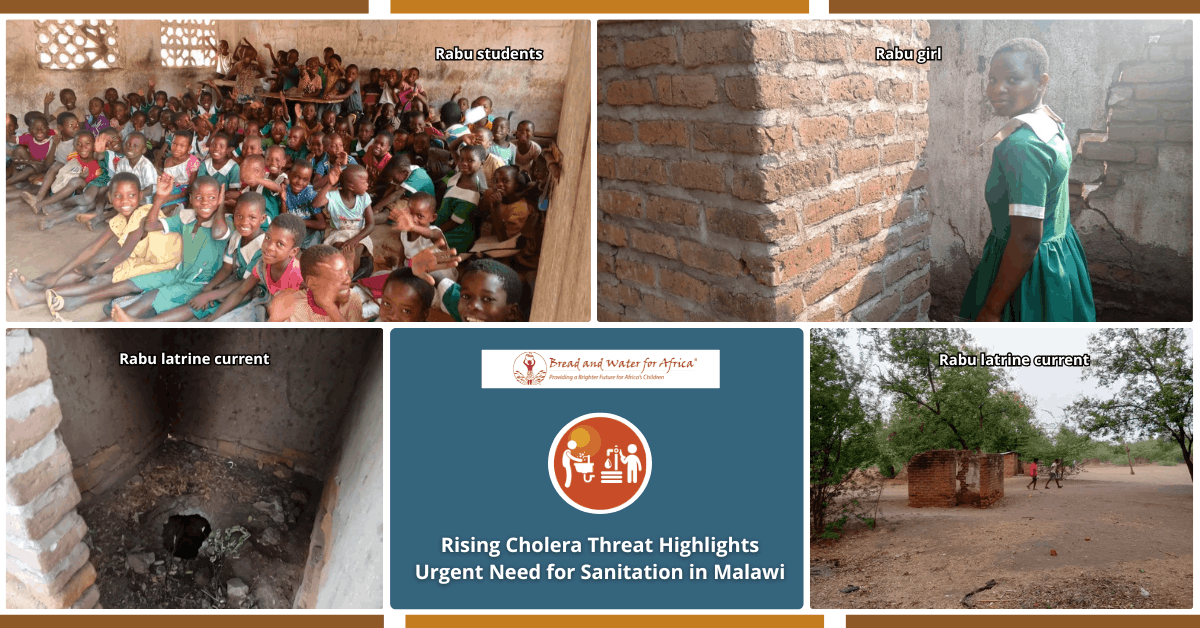
Among the countries affected is Malawi, where Bread and Water for Africa® is working with our in-country partner, the Faithful Heart Foundation (FHF), to provide toilet facilities to hundreds of students attending the Rabu Primary School in the country’s Chikwawa District.
Twenty-seven high-risk zones have been identified in the five countries, with vulnerabilities including poor water, sanitation, and hygiene infrastructure, as well as recurrent cholera outbreaks.
“The sharp rise in cholera cases in Southern Africa is a clear reminder of how climate-related shocks are intensifying public health risks,” said Dr. Marie Roseline Darnycka Belizaire, Emergencies Director at the WHO Regional Office for Africa.
And we are fearful that the worst is yet to come, as according to the WHO analysis, Southern Africa faces a critical period between March and August, with a projected 12,000 to 22,000 additional cholera cases under the most probable scenarios.
WHO notes that among the public health measures to minimize the impact of cholera in the region is the “improvement of water and sanitation services is crucial to protect the health of populations and avert a deterioration of the situation,” which is exactly what Bread and Water for Africa® is accomplishing through our WASH (Water, Sanitation, and Hygiene) program.
“Access to safe water, basic sanitation, and hygiene is essential to prevent cholera and other waterborne diseases,” states the WHO.
FHF chairperson Alex Steven Bango recently requested support from Bread and Water for Africa® to construct toilet facilities (latrines) to serve the 1,180 students (589 girls/591 boys) attending the Rabu Primary School.
“This project will assist both girls and boys at the school to have good sanitary facilities, which will help to reduce the desertion of students from school, school dropouts, spreading of diseases and well as improve students’ performance,” stated Alex in his grant request.
The need for toilet facilities at the school is great, as Alex bluntly puts it: “Students are defecating in poor, cracked, and damaged toilets, which makes some learners desert classes and miss some lessons, leading to poor performance during end-of-term examinations.
“Secondly, the number of students is very low because many of them become shy and not motivated as they were seen by passers because the toilets have very big cracks and holes which outsiders are able to see inside, therefore many girls won't use the present toilets,” he noted.
The Centers for Disease Control and Prevention (CDC) notes that people usually contract cholera from drinking water or eating food contaminated with cholera bacteria, and people “living in places with unsafe drinking water, poor sanitation, and inadequate hygiene are at the highest risk of getting cholera.
“Cholera can spread quickly in areas where sewage and drinking water aren’t adequately treated,” adds the CDC.
And tragically, the CDC states, “cholera can be fatal for up to 50 percent of people with severe disease.”
The National Library of Medicine reports that cholera remains a frequent cause of outbreaks globally, particularly in areas with inadequate WASH services. Cholera is spread through fecal-oral routes, and studies demonstrate that ingestion of Vibrio cholerae occurs from consuming contaminated food and water, contact with cholera cases, and transmission from contaminated environmental point sources.
At Bread and Water for Africa®, we have been working in recent years to prevent the transmission of cholera and other transmittable waterborne diseases through the construction of toilet facilities in the country, such as the Konzere Primary School in 2024.
“Thank you, Bread and Water for Africa®,” wrote the school’s girls’ matron, Debora Mkweya, in a letter of appreciation to the supporters of Bread and Water for Africa® on behalf of herself and hundreds of female students attending the school.
“You have improved our hygiene. We were always worried every time nature called. We were not comfortable coming to school on the days we visit the moon.
“The construction of these beautiful restrooms has indeed healed us all,” she wrote so poetically. “We are happy girls. Our concentration in class has surely improved. Hygiene and sanitation-related diseases will no longer be our guests.
“We are so grateful. We thank you for respecting the dignity of the girl child.”